


Does your business need an AI-powered chatbot?
An AI-powered chatbot for your business is worthwhile when you receive repetitive questions outside of business hours or before a sale; it's not worthwhile if your inquiry volume is low or your service relies on personal interaction. The key isn't having AI, but knowing what specific task you're going to delegate to it.
It's easy to hear about "AI agents" and feel like you're falling behind if you don't have one on your website. But a poorly designed chatbot doesn't solve anything: it simply shifts the problem from "I don't respond quickly" to "I respond quickly with useless answers." Before investing, it's wise to separate the trend from the real benefits for your business.
What has changed in business chatbots
Chatbots from a few years ago operated with fixed rules: if the customer typed a specific word, the bot would return a predefined response. As soon as the question deviated from the script, the system would freeze or repeat itself without understanding anything. This generated more frustration than help, and is the reason why many businesses abandoned the idea.
Today's AI-powered assistants understand natural language, maintain the context of the conversation, and can access real-time information about your business (hours, services, prices, availability) instead of being limited to saved phrases. According to the latest survey by the National Institute of StatisticsThe proportion of Spanish companies with 10 or more employees using artificial intelligence rose from 12.4% in the first quarter of 2024 to 21.1% in the first quarter of 2025, almost doubling in a year. The technology has matured; the question that remains is whether it fits with your way of working.
Key idea
An AI-powered chatbot doesn't replace your customer service. It filters and anticipates repetitive questions so you can dedicate human time to what truly needs it.
When is an AI chatbot worthwhile?
It's worthwhile when there's a clear pattern of recurring queries that someone currently has to answer manually each time. Some common examples in SMEs and among freelancers:
- Academias y centros de formación: constant questions about schedules, course prices, or if there are still places available.
- Clinics and consultations: Questions about whether they offer a specific specialty, whether they accept insurance, or how to make an appointment.
- Retail stores and small e-commerce businesses: product availability, shipping times, or return policy.
- Consulting firms and offices: Initial consultations to determine if the business can help with a specific case before scheduling a call.
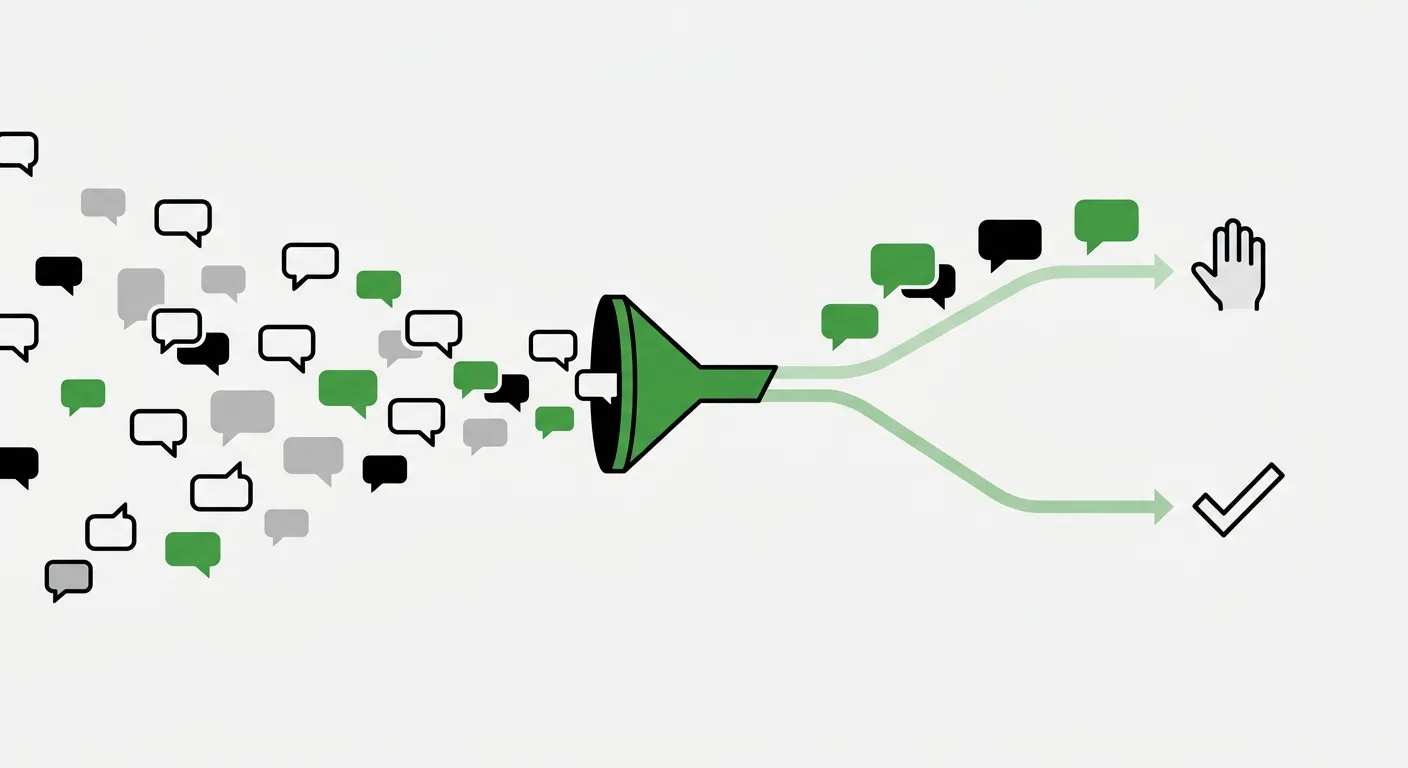
In these cases, the chatbot doesn't sell on its own: it filters out those who just wanted a quick piece of information and lets through those who are ready to talk to you. This filtering, outside of business hours, is what usually makes the difference between a cold lead and one that becomes a customer.
When it doesn't pay off
Not every business needs an AI assistant on its website, and forcing it can be expensive without yielding results. If your business receives few inquiries per month, setting up a chatbot is a disproportionate investment compared to the actual problem. It's probably more worthwhile to investigate why those few inquiries aren't converting into customers.
It also makes no sense if your differentiating factor is precisely your close and personalized attention. Automating the first response would convey the exact opposite of what you want to communicate. A boutique firm or a highly specialized practice, where each potential client deserves a tailored response from the very first message, can lose more than it gains by replacing that initial contact with a generic bot.
And it's not advisable if you're not clear on what information the assistant will handle. A chatbot that gives vague or fabricated answers about prices, deadlines, or conditions generates more distrust than not having a chatbot at all.
Practical tip
Before deciding, count your repeated consultations over the past month.
Review your WhatsApp messages, emails, or contact forms from the last month and note how many questions are repeated almost verbatim. If there are only a few, you probably don't need an assistant yet. If there are many, you already have a script of what the chatbot should handle.
What can an AI assistant actually do on your website?
Beyond simply answering individual questions, a well-configured assistant can handle specific tasks that are currently time-consuming:
- Answer frequently asked questions about services, indicative prices, opening hours or location, without waiting for you to open the business.
- Gather basic information about a potential customer (name, contact details, what they need) before passing it on to a person.
- Schedule a call or appointment by connecting to your calendar, without back-and-forth messages.
- Notify us when the query is complex or urgent, and refer it directly to you or your team instead of trying to resolve it alone.
This last point is what makes the difference between a useful chatbot and an annoying one: knowing when to be quiet and pass the baton to a human. An assistant that insists on solving everything on its own, even when it can't, is worse than having nothing at all.
How to integrate it into a WordPress website
On a WordPress website, the assistant is typically integrated as a chat widget visible in the corner of the screen, connected to your business information: catalog, hours, services, and, if needed, your calendar for managing appointments. It doesn't require redesigning the website or changing platforms; it's simply added to what you already have.
The important thing isn't the tool itself, but how it's configured: what information the assistant knows, what tone it uses, and when it should stop trying to answer and alert a person. An assistant connected to outdated information is worse than having no assistant at all.
Common mistakes when implementing an AI chatbot
- Failure to keep information updated. If prices or schedules change and the assistant doesn't update, it starts giving incorrect information.
- Not defining when to refer a person. A chatbot that goes around in circles without resolving anything frustrates more than it helps.
- Posting it without first checking the actual conversations. It's a good idea to test it with real customer questions before publishing it.
- Expect it to replace all customer service. Its function is to filter and expedite, not to replace human interaction in what really matters.

Quick checklist to find out if it's worth it for you
- You receive repeated questions almost every week via WhatsApp, email, or form.
- You lose contacts because they arrive outside of your hours and cool down before you respond.
- You are clear on what fixed information the assistant can handle without margin of error.
- Your business doesn't depend on the first contact always being a person.
- Someone will review and update the assistant's information periodically.
If you check most of these boxes, an AI assistant will likely save you real time. If you check only a few, the problem you want to solve might not be technological, but rather related to how your customer service is currently organized.
Frequently asked questions about AI chatbots for business
Can an AI chatbot replace a human running a business?
It shouldn't. Its function is to filter out repetitive questions and provide basic information, not to replace conversation when the customer needs something specific or personalized.
How long does it take to launch an AI assistant on the web?
It depends on how much information needs to be prepared and reviewed before publishing, but it's usually faster than redoing a website: the main work is in clearly defining what it should know and what it should derive from.
Do I need a lot of visits to my website for it to be worthwhile?
It's not just about visits, but about how many repeated questions you're currently handling manually. A business with moderate traffic but many similar inquiries can benefit more than one with more visits but few questions.
Can the chatbot give incorrect information to my customers?
This can happen if it's set up without clear boundaries or with outdated information. That's why it's important to define exactly what data it handles and when to acknowledge that it doesn't know and refer the matter to a qualified professional.
Is it possible to test it before publishing it on the final website?
Yes, and it's recommended. It's a good idea to review it with real customer questions before activating it, to identify any confusing answers or gaps in information that need to be filled in.
Conclusion
An AI-powered chatbot isn't a passing fad, nor is it a universal solution to a lack of time. It's a tool that only makes sense when there's a genuine pattern of recurring queries and someone willing to keep it updated. If that pattern doesn't yet exist, there are probably more useful steps to take first, such as analyzing why the inquiries you're already receiving aren't converting into customers.
Not sure if an AI assistant makes sense for your website?
We help you review your actual queries and decide if it's worthwhile before investing in anything.
Tell us what you want to improve